Source audio hdmi to vga converter for HDTV, Projector, Computer
Find 30 audio hdmi to vga converter options from verified Chinese manufacturers. Compare models like BS-HD020 and EL-B318 supporting 1080P resolution for HDTV, projector, and computer applications with customizable packaging and CE/RoHS certifications.
Key considerations
Products List




Comprehensive Sourcing Guide
Strategic Sourcing Guide for Audio HDMI to VGA Converter Solutions
Understanding Technical Specifications and Signal Conversion
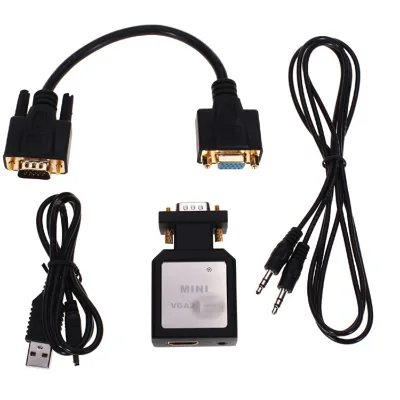
When sourcing an audio HDMI to VGA converter, the primary objective is to bridge the gap between modern digital video sources and legacy analog display systems. The core functionality of these devices relies on active signal conversion, as HDMI transmits digital signals while VGA (Video Graphics Array) requires analog RGBHV signals. Based on observed product attributes, the most prevalent configuration involves an HDMI input paired with a VGA output, often accompanied by an audio extraction feature to handle the separate audio stream that VGA cannot carry.
Buyers must verify the specific input and output port configurations. In the current market, models such as the BS-HD020 and EL-1318MINI demonstrate distinct capabilities. The BS-HD020 is explicitly noted for its HDMI to VGA conversion capability, supporting resolutions up to 1080P. This resolution limit is a critical technical specification, as many legacy projectors and monitors operate at 1080P, but some older equipment may be limited to 720P or 480P. The converter must support the specific resolution of the source device to ensure a clear image without scaling artifacts.
Furthermore, the inclusion of audio output is non-negotiable for a complete "audio HDMI to VGA" solution. While the video signal is converted to VGA, the audio must be routed separately. Product data indicates the presence of a 3.5 mm audio output interface in several models, such as the EL-B307. This allows the user to connect external speakers or headphones. Some advanced units, like the EL-1318MINI, may offer additional output ports, including AV (Audio/Video) or Component signals, providing flexibility for different display setups. Buyers should confirm whether the device supports stereo audio output via a 3.5 mm jack or if it requires a separate RCA connection, as the input ports vary between single HDMI and multi-port configurations like the 1VGA input found in specific legacy models.
The physical construction of the converter is also a technical consideration. The housing material is predominantly ABS Shell, which offers durability and heat dissipation properties essential for active electronic components. The standard dimensions observed, such as 66 x 55 x 20mm for the EL-1318MINI, suggest a compact form factor suitable for portable setups or tight desk spaces. However, variations exist, with some models adhering to a standard size of 651.5CM, while others may be designed as rectangular units with flexible designs. Understanding these physical constraints is vital for integration into existing AV racks or portable kits.
Compliance, Certification, and Regulatory Standards
In the global B2B market, compliance is a prerequisite for market entry and liability protection. When sourcing these converters, buyers must verify that the products meet international safety and environmental standards. The observed product data highlights that many units carry CE, RoHS, and Reach certifications. These are not merely marketing labels but essential indicators of compliance with European Union directives regarding electromagnetic compatibility, hazardous substances, and chemical safety.
The CE marking confirms that the product conforms to health, safety, and environmental protection standards for products sold within the European Economic Area. RoHS (Restriction of Hazardous Substances) compliance ensures that the device does not contain lead, mercury, cadmium, or other toxic materials above specific thresholds, which is critical for environmental regulations in many jurisdictions. Reach certification further validates that the chemical substances used in the manufacturing process, including the ABS shell and internal wiring, are registered and safe for human health and the environment.
Buyers should also scrutinize the material standards. The use of "red copper wire" is a specific observation in the product data, indicating high-quality conductive materials for signal transmission. Red copper is preferred over copper-clad aluminum (CCA) for its superior conductivity and resistance to corrosion, which directly impacts signal integrity and long-term reliability. However, buyers must verify this claim through documentation, as "red copper" is a material description that requires confirmation against actual supplier specifications.
Additionally, the product origin is a key factor in compliance. The majority of the observed products are made in China, with specific manufacturing hubs identified in Shenzhen. While this is a major global electronics manufacturing center, buyers must ensure that the specific factory holds the necessary ISO certifications and that the batch of goods being purchased carries valid test reports from accredited laboratories. The absence of a specific certification number or a valid test report from a recognized body should be treated as a red flag, regardless of the supplier's verbal assurances.
Cost Drivers and Pricing Structures
The pricing of audio HDMI to VGA converters is influenced by several variables, including component quality, certification status, and order volume. The observed price range in the market spans from $0.10 to $55.00 USD. This wide disparity indicates a highly segmented market ranging from basic, unbranded adapters to premium, feature-rich units with robust shielding and high-grade components.
The lower end of the price spectrum, likely around $0.10 to $5.00, typically corresponds to basic adapters with minimal shielding, standard ABS shells, and basic copper wiring. These units may lack advanced features like built-in audio extraction or high-resolution support beyond 720P. In contrast, the higher end of the range, approaching $55.00, suggests units with premium build quality, such as aluminum alloy shells, advanced chipsets for better signal conversion, and comprehensive certification packages. These units often support higher resolutions, include multiple output options, and feature superior packaging.
Order Volume (MOQ) is another significant cost driver. The observed MOQ range is between 10 and 1000 units. Buyers purchasing small quantities, such as 10 units, will likely face a higher unit cost due to the lack of economies of scale. Conversely, orders approaching the 1000-unit threshold may unlock significant price reductions. However, buyers must balance the cost savings against the risk of inventory holding. For B2B procurement, it is advisable to negotiate based on tiered pricing structures where the unit cost decreases as the order volume increases.
Packaging also influences the final cost. The data shows variations in packaging, including Bag/Carton, PE Bag, Color Box, and Blister Packing. Premium packaging, such as Color Box or Blister Packing, adds to the unit cost but is essential for retail-ready products. For bulk industrial use, simple Bag/Carton or PE Bag packaging may suffice, reducing the overall cost. Buyers should explicitly define their packaging requirements to avoid paying for unnecessary retail features when they are not needed.
Typical Applications and Use Cases
The versatility of audio HDMI to VGA converters makes them suitable for a wide array of applications. The observed product attributes list a broad range of compatible devices, including HDTV, DVD players, Computers, Projectors, Speakers, Home Appliances, and Multimedia systems. This indicates that the converters are designed to serve both consumer and professional environments.
In educational and corporate settings, these converters are frequently used to connect modern laptops and desktop computers to older projectors or interactive whiteboards that only accept VGA inputs. The ability to convert HDMI signals from a laptop to a VGA-compatible projector ensures that presentations can be delivered without requiring expensive hardware upgrades for the display infrastructure. The support for 1080P resolution is particularly relevant here, as it ensures that high-definition content is displayed clearly on large screens.
For home entertainment systems, the converters allow users to connect gaming consoles, Blu-ray players, or streaming devices to older televisions or monitors. The inclusion of audio output is crucial in this context, as it allows the user to enjoy the full audio-visual experience even when the display device lacks HDMI inputs. The compatibility with devices like iPhones, iPods, and iPads, as noted in some product attributes, highlights the utility of these converters in mobile media consumption scenarios.
In the industrial and commercial sectors, these converters are used in surveillance systems, digital signage, and control rooms where legacy VGA monitors are still in operation. The ability to handle Component signals and AV outputs in some models, such as the EL-A123, provides additional flexibility for connecting older video sources. The "Twisted Pair" designation in some product attributes suggests specific use cases involving signal transmission over longer distances, which is beneficial in large office buildings or warehouses.
Supplier Evaluation and Quality Control
Selecting the right supplier is critical to ensuring product reliability and consistency. Buyers should prioritize suppliers who provide transparent documentation regarding their manufacturing processes and quality control measures. The observation of specific product models, such as the EL-1317 and EL-1101B, suggests that established manufacturers have distinct product lines. Buyers should verify that the supplier can consistently produce these specific models with the claimed specifications.
Quality control should focus on several key areas. First, the integrity of the signal conversion must be tested to ensure that the 1080P resolution is supported without flickering or color distortion. Second, the durability of the ABS shell and the quality of the connectors must be assessed. The connectors, specifically the HDMI and VGA ports, should be robust and capable of withstanding repeated plugging and unplugging. Third, the audio output quality should be verified to ensure clear sound transmission without interference or noise.
Buyers should also evaluate the supplier's ability to provide customization. The observed attribute "Customization: Available" indicates that suppliers may offer options for branding, packaging, or even specific technical modifications. This flexibility is valuable for B2B buyers who need to align the product with their corporate identity or specific technical requirements. However, buyers must ensure that any customization does not compromise the product's compliance with safety standards.
Finally, the supplier's location and logistics capabilities should be considered. With the majority of products originating from China, specifically Shenzhen, buyers should be aware of the potential lead times and shipping costs. Shenzhen is a major electronics hub, which generally ensures a steady supply of components and efficient manufacturing. However, buyers should confirm the supplier's ability to meet delivery deadlines and handle any potential logistics disruptions.
Long-Term Procurement Considerations
Sourcing audio HDMI to VGA converters is not just a one-time transaction but a long-term relationship that requires careful planning. Buyers should consider the lifecycle of the product and the availability of spare parts or replacements. As technology evolves, the demand for HDMI to VGA converters may fluctuate, but the persistence of legacy VGA equipment ensures a continued need for these solutions.
Buyers should also monitor the market for changes in standards and regulations. As new display technologies emerge, the relevance of VGA may diminish, but the transition period will likely be long. Therefore, maintaining a relationship with a reliable supplier who can adapt to changing market demands is essential. This includes the ability to source alternative products or upgrade existing models to meet new requirements.
Inventory management is another critical aspect. Given the wide price range and varying MOQs, buyers should develop a strategy that balances cost efficiency with inventory turnover. For high-demand items, maintaining a buffer stock may be necessary to prevent supply chain disruptions. For lower-demand items, a just-in-time approach may be more appropriate.
Finally, buyers should establish clear communication channels with their suppliers to address any technical issues or quality concerns promptly. Regular audits and feedback loops can help maintain high standards and ensure that the supplier continues to meet the buyer's expectations. By focusing on these long-term considerations, buyers can build a resilient supply chain that supports their operational needs for years to come.
FAQs
What resolution does the audio hdmi to vga converter support?
The device supports a maximum resolution of 1080P for clear video output. This specification ensures compatibility with most modern HDTVs and projectors while maintaining image clarity during signal conversion.
Which certifications do these converters typically hold?
Most units carry CE, RoHS, and Reach certifications for safety and environmental compliance. These marks confirm the product meets international standards for hazardous substances and electromagnetic compatibility in global markets.
Can I find custom packaging options for bulk orders?
Customization is available for specific packaging needs like color boxes or blister packs. Buyers should verify if the supplier can adjust the standard bag or carton packaging to match their branding requirements.
How do I connect audio when using a VGA output?
Audio is routed separately through a 3.5 mm audio output interface since VGA carries video only. Some models also offer AV or component signal outputs for additional audio and video flexibility.
What is the typical MOQ for purchasing these converters?
The minimum order quantity ranges from 10 to 1000 units depending on the supplier. Lower MOQs allow for smaller test orders, while larger volumes may unlock better pricing tiers.
Where are these audio hdmi to vga converters manufactured?
The products are primarily made in China, with specific manufacturing hubs located in Shenzhen. This region is a major electronics center known for efficient production and component availability.